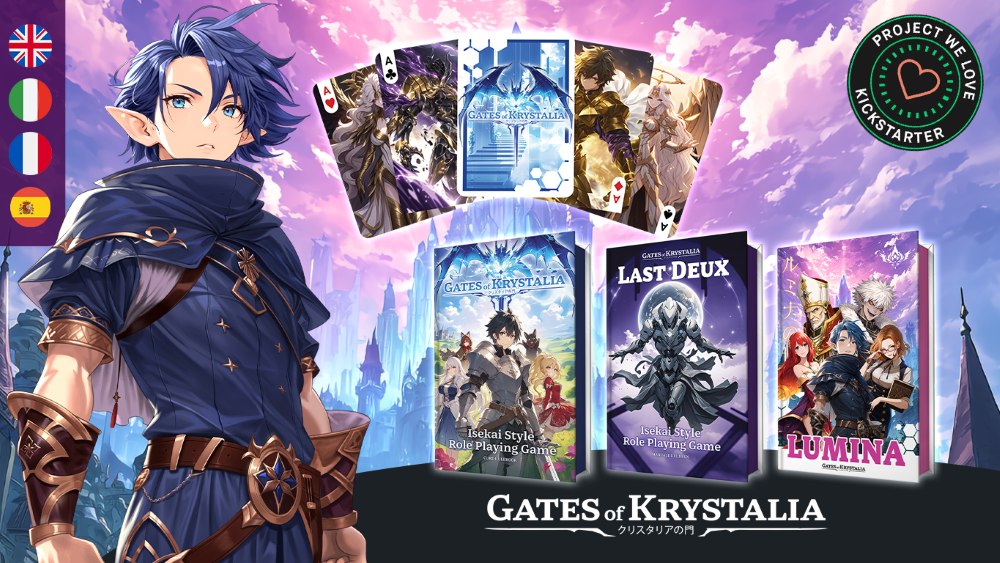
Morgen startet der Kickstarter Rollenspiel-Kartenspiel-Mix "Gates of Krystalia: Lumina" (Link). Der basiert auf dem gleichnamigen Anime-Rollenspiel (Link), welches trotz deutschsprachigem Regelwerk hierzulande verhältnismäßig unbekannt ist. Vielleicht gleich nicht mehr, denn ich habe die beiden Schöpfer Alberto Dianin & Andrea Ruggeri ins Interview gebeten. Achtung, diesmal ist das Interview in englischer Sprache, da die beiden kein deutsch konnten und ich kein italienisch ;-)
Hello Alberto & Andrea. Why don't you start by introducing yourself to the blog fans?
Hello readers! We’re Alberto Dianin and Andrea Ruggeri, and we’re excited to share our story with you.
Andrea has over twenty years of experience in tabletop role-playing games. A former game store owner, he has built a strong network within the Italian RPG community over the years, an invaluable resource for the project. But Andrea isn’t “just” a game designer: he’s also a professional graphic designer specialized in typography, and you can feel that in every page of "Gates of Krystalia" (GoK). His obsession with visual detail and his deep understanding of game mechanics are the beating heart of the project.
Alberto is an entrepreneur in the publishing world and the owner of two small publishing houses focused on non-fiction for English-speaking markets and the major European languages. He trained as a civil engineer, then shifted into publishing to build something of his own, something that could combine different personal skills and create products useful to a broad audience. He initially started working with Andrea on graphic services such as covers and book formatting, and that collaboration eventually grew into something bigger, leading to the creation of the tabletop RPG project "Gates of Krystalia". Within GoK, Alberto handles investments, supplier relationships, logistics, organic and paid marketing strategy (and execution), and every step of the publishing process. These skills proved essential to turn a dream into a real product on store shelves—covering everything from customer management to relationships with distributors, as well as networking with other creators and influencers. He is also highly experienced in crowdfunding, with five successful "Gates of Krystalia" campaigns funded through Kickstarter (Link), Ulule (Link), Game On Tabletop (Link) & Catarse (Link).
Andrea, how did you get into role-playing as a hobby?
Role-playing games hooked me because they’re not just games, they’re shared experiences. You sit at a table with friends and build something together: story, tension, character arcs, memorable moments. On top of that, I grew up with anime and JRPG culture, so the idea of progression, dramatic stakes, and cinematic storytelling always felt natural to me. GoK is basically where those passions meet tabletop play.
And how did your career progress from player to game developer?
It started as collaboration. Andrea and I worked together on publishing-related tasks, and at some point we realized we had the right combination of skills to build something larger, something that could actually ship as a professional product. Game development is only part of the journey. To bring a game to market, you also need structure, production planning, distribution, communication, community building, and financial sustainability. My path into GoK happened exactly there: building the pipeline that turns a creative vision into something players can hold and play.
One special feature of GoK is its anime style. Do you have a particular interest in this topic?
Absolutely. For us, anime is not only a visual style, it’s a storytelling language. Anime has a specific emotional rhythm: powerful growth arcs, explosive moments, quiet reflective scenes, and very character-driven drama. We didn’t want a game that simply looks anime. We wanted a system that plays like anime feels.
Let's talk about your role-playing game: what is GoK actually about?
"Gates of Krystalia" is about people from a modern reality being pulled into a fantasy multiverse called Lumina through mysterious Gates. You wake up in a world with new rules, new dangers, and new possibilities, and you grow from ordinary to legendary through choices, bonds, and hard-earned victories.
GoK describes itself as an isekai-style RPG. What exactly does that mean?
“Isekai” means another world. In GoK, that’s not just flavor, it’s the core premise: characters arrive from a familiar world into an unfamiliar one. This creates a very strong sense of discovery and identification. Players naturally ask the same questions their characters would ask, and the learning curve becomes part of the narrative, just like in many isekai stories.
There are many role-playing games out there, including a few in anime style. What makes GoK so special or unique, both in terms of game mechanics and setting?
Two main pillars:
1. A fully card-based RPG system (no dice): Your 52-card deck represents your Vital Energy. You spend cards to act, fight, and push beyond your limits. When your deck runs out, you collapse. It creates visible, physical tension at the table: you literally see your stamina disappearing.
2. A multiverse setting built for genre variety: Lumina is a hub world connected to other realms through Gates. Each Gate can open a different anime sub-genre experience (classic fantasy, mecha vibes, urban exorcism, superhero-inspired worlds, and more). That means one ruleset can support very different campaign tones without losing identity.
And that brings us to the mechanics. How exactly does the rule system work?
The core idea is simple: instead of rolling dice, you use cards as both randomization and resource. Every decision has weight because your power is tied to the same resource that keeps you standing.
Combat is fast and cinematic, built around Combat Techniques, special moves designed to feel like anime signature attacks. It keeps the pace high and the choices tactical without becoming math-heavy.
And how does character creation work?
Character creation is guided and accessible. You build your hero by choosing key elements like affinities, abilities, and Combat Techniques that define how you play. The goal is that you can start quickly, but still have meaningful customization and growth over time.
What type of player is the system intended for? More for narrative game fans or power gaming rule experts?
GoK is designed to welcome anime fans and newcomers who feel intimidated by traditional tabletop RPG complexity, while still offering depth for experienced players who enjoy optimization and tactical choices. If you love narrative, GoK supports cinematic storytelling and character arcs. If you love strategy, deck and resource management plus build choices give you plenty to master.
And what other role-playing game could GoK be compared to, so that readers can get a rough idea?
Mechanically, it often clicks with people who enjoy card games (TCGs) because the deck is central and meaningful. In terms of table experience, it can be a great alternative for players coming from traditional fantasy RPGs who want something more cinematic and less dependent on swingy dice results, especially if they love anime and JRPG pacing and progression.
What is the current status of the game? What is already available for purchase? What is planned for the future?
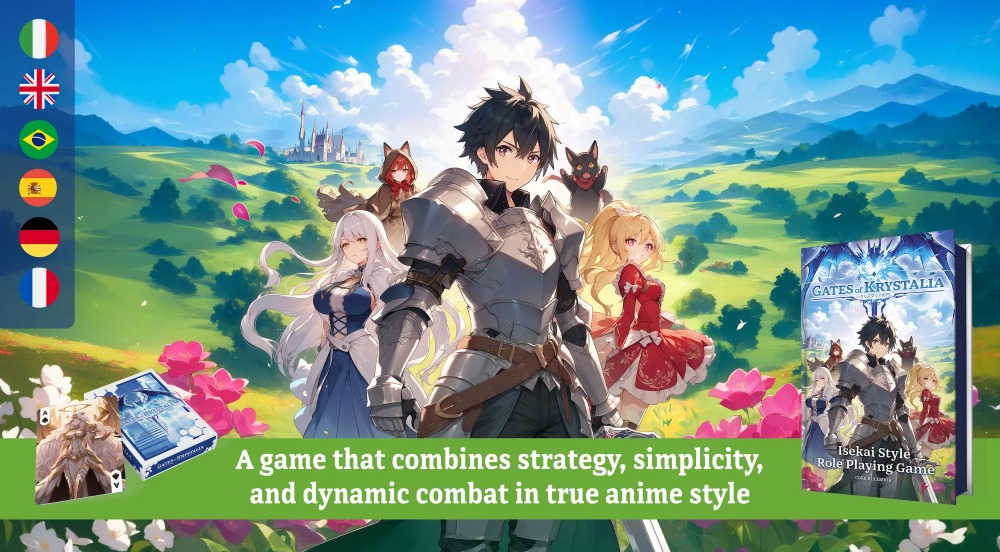
"Gates of Krystalia" already has multiple published products available in both digital and physical formats. The Core Rulebook is the heart of the system: it includes the full ruleset, the core mechanics, and everything you need to start playing. From the very beginning, though, we knew that "Lumina" was far too vast to fit into a single book. To truly explore it, we needed expansions that open new ways to play, not just “more content”. That’s exactly how "Last Deux" was born: as an expansion designed to address multiple community requests at once. First, we wanted to give the Narrator (Deux) advanced tools and rules to better handle preparation and session flow, pacing, events, NPCs, enemies, and adventure structure. At the same time, we developed dedicated support for solo play, with procedures, tables, and generators that allow scenes and events to function even without a human narrator. Finally, we used "Last Deux" to introduce new settings and advanced options that simply couldn’t fit inside the Core Rulebook. The result is a hybrid product: a toolbox that enhances group play and, when needed, can also turn into a compelling single-player experience, while keeping the full freedom of a tabletop RPG.
The next major step is "Lumina", a new expansion that deepens the setting and adds new systems like organizations and guild structures, territories, and major worldbuilding progression. Beyond that, we plan further themed expansions tied to the Gates, more narrative content, and stronger digital support tools for the community. If you’re reading this article before February 3rd, 2026 at 17:00 (CET), the best way to support the project is to follow the Kickstarter pre-launch page, this small action helps a lot with visibility at launch. If you’re reading it after that date and time, the campaign will already be live and you’ll be able to support it directly.
Inside the "Lumina"-Kickstarter you’ll find both all products from previous "Gates of Krystalia" launches and a new wave of brand-new content. Returning items include the core books, card decks, playmat, tokens, card binder, bookmark, stickers, and many other accessories. On top of that, "Lumina" introduces new releases such as the Expansion Book (with a Kickstarter-exclusive dust jacket on selected tiers), the Lumina Light Novel, Lumina Yaoi, the Territorial Card Deck, the Lumina Coin, a Kickstarter-exclusive Lumina Art Print, and more. You’ll find the new expansion, campaign-exclusive items, and all the core products needed to start playing.
Finally, Andrea, do you have any tips and tricks for aspiring role-playing game developers?
A few things I learned the hard way:
- Design your difference first. If your game doesn’t have a clear identity, it’s hard for players to remember it.
- Playtest earlier than you think you should. Iteration beats theory.
- Clarity is game design. A brilliant system fails if it’s not explained cleanly.
- Build community before you need it. The best marketing is a group of players who genuinely care.
- Treat production as part of the product. Layout, editing, art direction, and usability matter as much as mechanics.
-If you can combine passion with consistency, finishing, improving, and showing up, your game has a real chance.
Dann vielen Dank für das Interview :-) Anbei noch der Werbung für den aktuellen Kickstarter: